Perceptual
Computational Cognitive & Translational Neuroscience
From how experts see to how the brain understands.
Overview
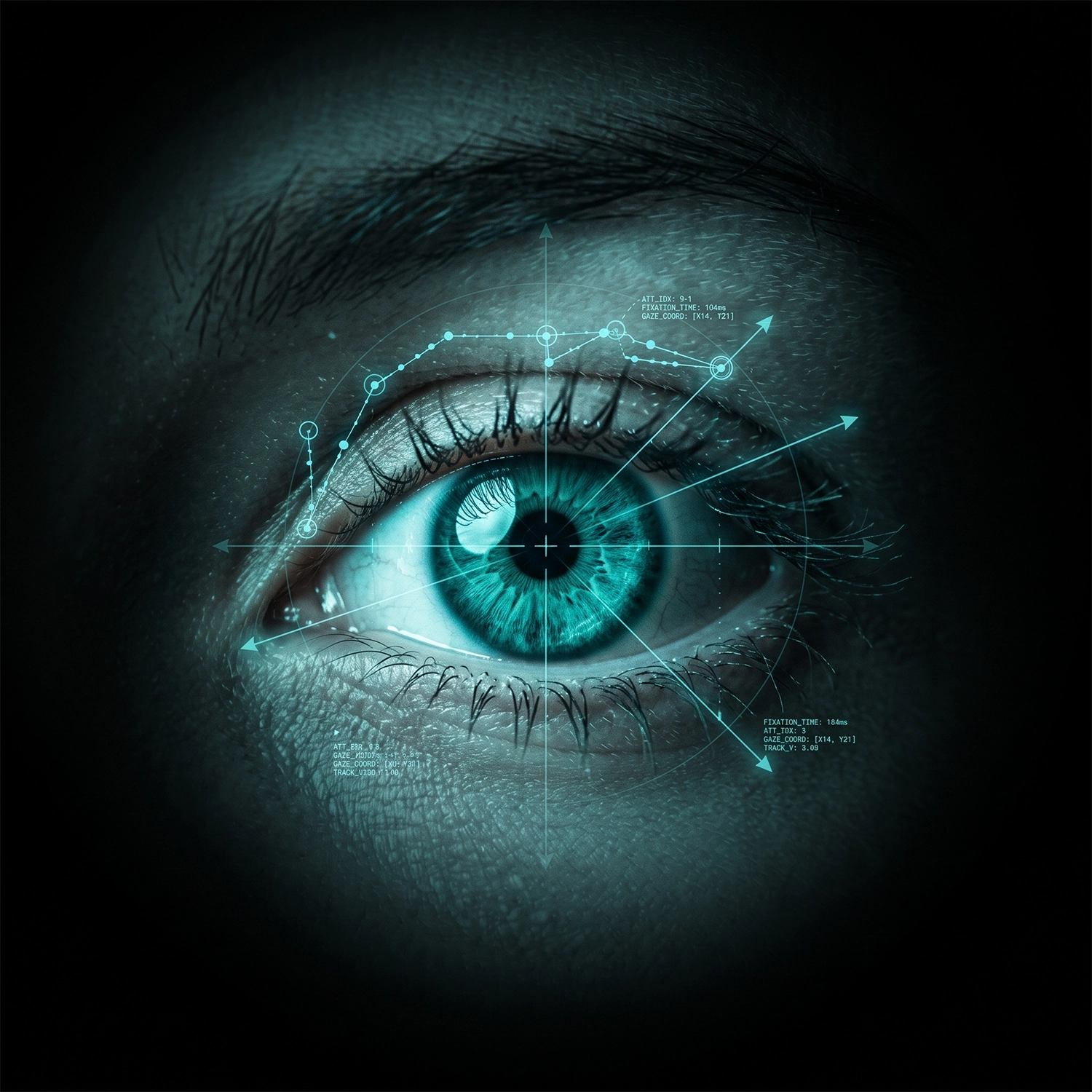
Computational Cognitive & Translational Neuroscience studies how the brain perceives, attends and understands, and how those processes can be measured, modelled and put to clinical use. It is where the lab's computational methods meet cognition and behaviour. A distinctive strand of this work is the study of visual expertise: using eye-tracking and scanpath analysis to understand how experts such as radiologists and neurosurgeons search and interpret complex medical images, with implications for training and for building systems that align with human reasoning. Alongside this we work with magnetoencephalography (MEG) and other neural signals to probe perception and cognition directly, and we pursue translational questions that connect cognitive neuroscience to real clinical and educational settings. The emphasis throughout is translation, turning measurements of cognition into tools and insights that reach practice.
Methods
Techniques & approaches
The computational methods that underpin this research area
Radiomics
Publications
Selected publications in this area

Journal article
2024
Characterizing visual neurosurgical expertise in brain MRI visualization using eye-tracking and 3D fractal dimension analysis
Kumari P., Azemi G., Russo C., Ieva A.D.
Journal of Eye Movement Research

Journal article
2024
SoftMatch: comparing scanpaths using combinatorial spatio-temporal sequences with fractal curves
Newport R.A., Russo C., Liu S., Suman A.A., Di Ieva A.
Sensors
Book chapter
2024
Computational and translational fractal-based analysis in the translational neurosciences: an overview
Di Ieva A.
The fractal geometry of the brain
Book chapter
2024
Fractal dimension studies of the brain shape in aging and neurodegenerative diseases
Davidson J.M., Zhang L., Yue G.H., Di Ieva A.
The fractal geometry of the brain
Funding
Selected funding in this area
Grants supporting our computational neuroimaging research programme
Macquarie University
CEPET Research Centre
$150,000
CEPET Research Centre
Macquarie University
AI platform for how the brain perceives complex images
$103,309
Research Infrastructure Scheme (MQRIS-S)
Macquarie University
Biomarkers of pain control after spinal cord stimulation
$50,000
Research Acceleration Scheme (MQRAS)
Macquarie University
What musicians are looking at
$4,000
CEPET Start-up Grant
Browse publications.
Join our work.
Explore the full body of CNS Lab research or contact us to discuss collaboration opportunities.